



 Contacts
PRODUCT QUALITY AND CONFORMITY
In an increasingly demanding and competitive global market, quality and compliance with the highest international standards represents a fundamental and essential objective for us. This translates into our daily commitment to researching cutting-edge technologies, which allow us to test our garments and obtain specific certifications relating to safety, durability, colour fastness, resistance of the garments, essential characteristics especially as concerns work and high visibility clothing, as well as for gloves and safety shoes. Our attention towards and compliance with international standards are a guarantee of transparency and trust. Each certification is in fact the result of rigorous control processes carried out in-house and in collaboration with certified bodies, to offer innovative solutions, compliant with current regulations.
 .
.Internationally recognised certification for the sustainable production of clothing and textile products made from recycled materials.
 .
.The most important international standard for the responsible and sustainable development of products made with natural fibres from organic farming, such as cotton.
 .
.The largest cotton sustainability program in the world, with the aim of making cotton cultivation increasingly sustainable.
 .
.Internationally recognised certification for the sustainable production of garments and textile products made with at least 5% recycled materials.
 .
.Internationally recognised certification for the sustainable production of garments and textile products made with at least 5% organically grown raw materials.
PERSONAL PROTECTIVE EQUIPMENT
Regulation (EU) 2016/425 establishes the requirements for the design and
manufacture of Personal Protective Equipment (PPE) made available on the market
and establishes rules on the free movement in the European Union. The CE
marking certifies that the product has been assessed by the manufacturer and
that it complies with EU requirements regarding user health and safety, and
environmental protection.
The United Kingdom has established its own conformity marking (UKCA) but has
also extended recognition of the CE marking indefinitely. Therefore, the
self-declaration methods of the CE marking also apply to the UKCA marking.
Where, however, mandatory conformity assessment by notified bodies is required,
this must also be expressly issued for the UKCA marking.
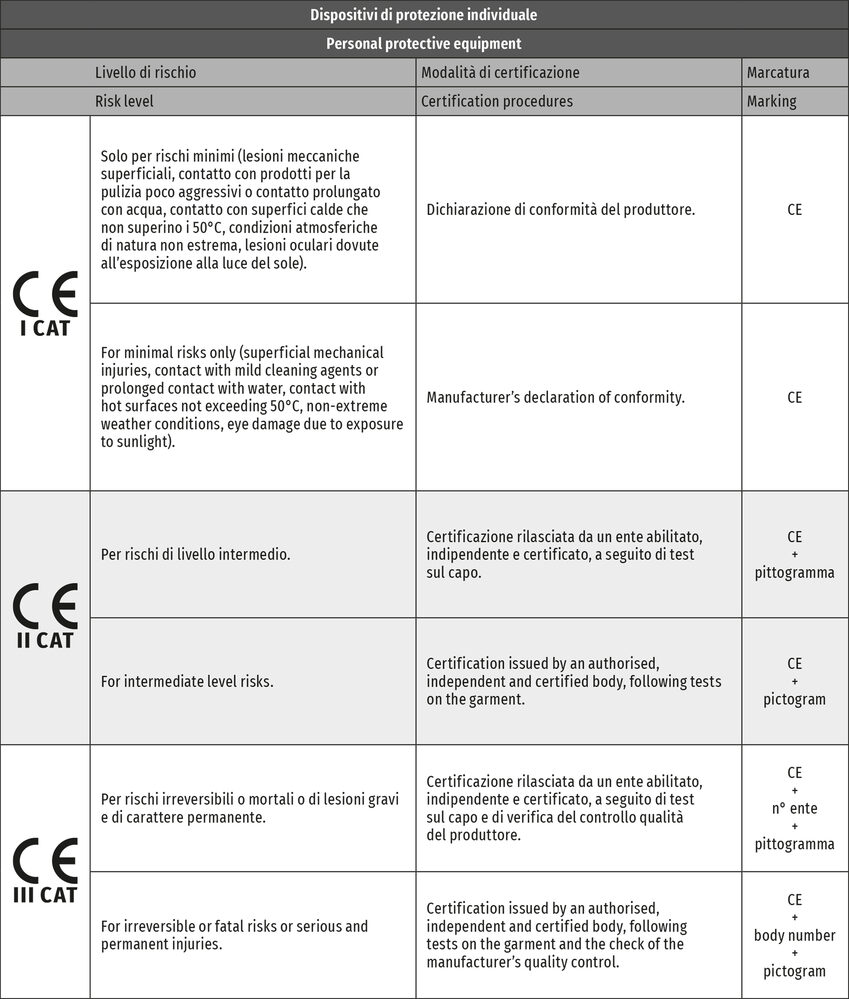
The PPE classification is carried out by increasing Risk Categories, as per the
following table.

WORKWEAR
GENERAL REQUIREMENTS EN ISO 13688
The general requirements governing the classification of workwear are contained in EN ISO 13688. This standard establishes the general performance requirements for the ergonomics, safety, sizes, wear, compatibility and marking of protective clothing and the information that must be provided by the manufacturer together with the protective clothing. The standard is intended to be used together with other standards containing specific performance requirements. Below are the pictograms in the catalogue and the specific regulations.
GLOVES
GENERAL REQUIREMENTS EN 21420
The
general requirements that regulate gloves intended for protection from
occupational risks are contained in the EN 21420 standard. The standard defines the general requirements of protective gloves in terms of design and manufacture, safety, comfort and efficiency,
marking and information. The standard can also be applied to sleeves for
protecting the forearm or arm. Some gloves specifically designed for
special applications are governed by other specific standards.
EN 388: PROTECTION FROM MECHANICAL RISKS
EN 407: PROTECTION FROM THERMAL RISKS (HEAT AND
FLAMES)
EN 12477: WELDING PROTECTION
EN 511: PROTECTION FROM THE COLD
EN ISO 374: PROTECTION AGAINST CHEMICAL RISKS AND MICROORGANISMS
ANSI – ISEA 105-2016
In addition to certifications complying with
Regulation (EU) 2016/425, for some gloves the ANSI-ISEA certification is also
required. The American National Standards Institute (ANSI), a private
non-profit organisation, and the International Safety Equipment Association
(ISEA), a trade association of manufacturers of personal protective equipment,
jointly define industry standards for the United States, which are also
recognised globally. The test methods taken as reference are established by
ASTM International (American Society for Testing and Materials International).
As for the "EN ISO 13997 cut resistance"
certification of the EU Regulation, the checks are implemented using the
Tomodynamometer - TDM Test but the measurement index is not the Newton but the
Gram, as per the following table.
5.1.1: CUT RESISTANCE (ASTM F2992-15)
The abrasion test measures how well a glove
withstands loss of material from rubbing on rough surfaces. The higher the
number of revolutions shown, the greater the resistance to abrasion. The
abrasive wheels have a vertical load of 500 g for levels 0 to 3 and a load of
1000 g for levels 4 to 6.
5.1.4: RESISTANCE TO ABRASION (ASTM D3389-10 - ASTM
D3884-09)


SAFETY SHOES
UNI EN ISO 20344 TEST METHODOLOGY AND GENERAL REQUIREMENTS
The EN ISO 20344 standard establishes
the basic requirements and, where appropriate, the test methods to verify
compliance with said requirements, for footwear designed to protect the feet
and legs of the wearer against foreseeable risks in various occupational
sectors. The standard can only be used in conjunction with EN ISO 20345, EN ISO
20346, EN ISO 20347, which establish footwear requirements based on specific
risk levels.
CLASSIFICATION OF THE FOOTWEAR
Type I. Footwear made of leather and
other materials, excluding polymeric products.
Type II. Footwear made entirely from rubber or entirely from polymeric
material, which is in any case impermeable and designed for those who work in
environments where there is water, mud or liquids.
UNI EN ISO 20345
UNI EN ISO 20346
UNI EN ISO 20347
SLIP-RESISTANCE OF SOLE
ESD = ELECTROSTATIC DISCHARGE
ADDITIONAL MARKINGS